10 Common Compliance Risks in Real Estate Listings (And How to Avoid Them)
Learn the 10 most common compliance risks in Australian real estate listings and how agencies can avoid misleading advertising under ACL Section 18.
Safe Listing AU
3/20/20262 min read
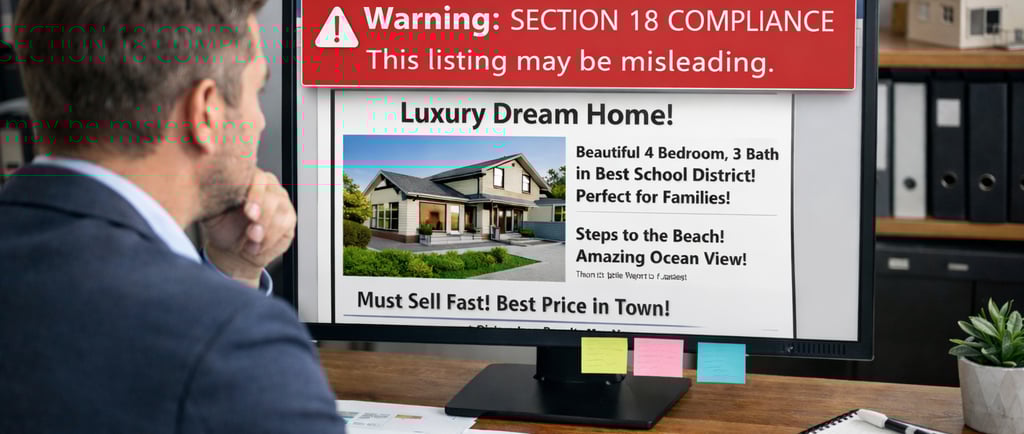
Property advertising is a core part of the real estate industry, but it also carries legal responsibilities. Under Australian Consumer Law (ACL), real estate agents must ensure that marketing materials do not contain misleading or deceptive statements.
With the growing use of AI tools to generate listing descriptions, the risk of unintentionally publishing misleading language has increased.
Below are ten of the most common compliance risks that can appear in property listings — and how agencies can avoid them.
1. Unsupported Superlatives
Statements such as:
“The best home in the area”
“Unmatched lifestyle opportunity”
“The perfect family home”
These types of claims are subjective and can be considered misleading if they imply facts that cannot be proven.
Tip: Use factual descriptions rather than exaggerated claims.
2. Misleading Renovation Claims
Listings often include statements such as:
“Recently renovated”
“Fully upgraded”
“Brand new kitchen”
If renovations were only cosmetic or partial, these claims could be considered misleading.
Tip: Be specific about what was updated.
Example:
“Kitchen updated with new benchtops and appliances in 2023.”
3. Incorrect Property Features
Incorrect details about:
Bedrooms
Bathrooms
Parking spaces
Land size
Even simple mistakes in property features can lead to complaints or legal disputes.
Tip: Always verify listing details against the property file before publishing.
4. Misleading Location Descriptions
Phrases such as:
“Beachside living”
“City views”
“Walking distance to schools”
These claims can be problematic if the property does not reasonably meet those descriptions.
Tip: Avoid location claims that could be interpreted as guarantees.
5. Overstating Development Potential
Statements such as:
“Subdivision potential”
“Future development opportunity”
These claims may require council approvals or zoning conditions.
Tip: Only mention development potential if supported by verified zoning information.
6. Using AI Without Proper Review
AI-generated listings may produce persuasive marketing language that includes:
exaggerated descriptions
unsupported claims
subjective language
Even if the content was generated by AI, the agency is still responsible for the final listing.
Tip: Always review AI-generated content before publication.
7. Selective Disclosure
Sometimes listings highlight positive features while omitting known limitations.
For example:
mentioning “water views” but failing to mention a major road directly in front of the property.
This can create a misleading impression for buyers.
8. Ambiguous Marketing Language
Words like:
“spacious”
“luxury”
“premium”
“designer”
These terms can be interpreted differently by buyers and may create unrealistic expectations.
Tip: Pair subjective language with factual descriptions.
9. Outdated Information
Listings sometimes remain online after:
price changes
property updates
withdrawn features
Outdated marketing information can also create misleading impressions.
10. Lack of Documentation
One of the biggest compliance risks is not having any record showing that the listing was reviewed before publication.
If a complaint arises, agencies may need to demonstrate that they took reasonable steps to ensure accuracy.
Having a documented review process can help agencies show that listings were checked before going live.
Why Compliance Matters More With AI
AI tools are making it easier than ever to generate property marketing content quickly. However, speed can also increase the risk of errors or exaggerated statements slipping through.
That’s why many agencies are beginning to introduce structured compliance checks as part of their listing workflow.
Combining AI efficiency with proper review processes allows agencies to benefit from technology while still managing legal risk.
Final Thoughts
Property advertising plays a crucial role in attracting buyers, but it also carries legal responsibilities.
By understanding the most common compliance risks and introducing a proper review process, real estate agencies can reduce the chance of misleading advertising and protect themselves from potential regulatory issues.
Check a listing free- https://safelisting.au
Contact
Safe Listing AU
Helping real estate agencies publish compliant property listings with confidence.
Built for Australian advertising standards. No lock-ins. Cancel anytime.
Phone
info@safelisting.au
Disclaimer
© 2025. Safe Listing AU All rights reserved.
Safe Listing AU provides automated assistance to help identify potential errors or compliance risks in property listings. It does not provide legal advice. Users remain responsible for ensuring compliance with applicable laws and regulations.
0418667741
Terms of service
Privacy Policy